
Spoon
Unknown Artist
16th–17th century
Medium
Silver
Dimensions
Length: 7 7/8 in. (20 cm)
Classification
Metalwork-Silver
Culture
possibly Hungarian
Department
European Sculpture and Decorative Arts
Museum
Metropolitan Museum of Art, New York, NY
Credit
Gift of The Salgo Trust for Education, New York, in memory of Nicolas M. Salgo, 2010
Accession Number
2010.110.74
Rights
Public Domain
Tags
Art Historical Context
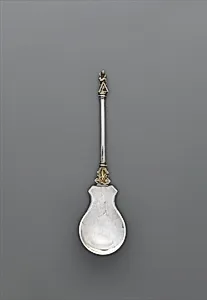
This elegant silver spoon, dating to the 16th–17th century and possibly of Hungarian origin, exemplifies the exquisite metalwork of European decorative arts. Measuring just 7 7/8 inches (20 cm) in length, it transforms a utilitarian object into a work of art through its finely crafted silver form. Crafted by an unknown artist, such spoons were prized possessions, often showcasing the technical mastery of silversmiths who chased, engraved, or embossed intricate designs into the precious metal. The spoon's handle likely features religious iconography, including Apostles, the Madonna and Child, and a Cross—themes central to Christian devotion during this era of Renaissance and early Baroque artistry. These motifs reflect the period's deep piety, amid the Counter-Reformation's emphasis on sacred imagery, and may have held personal or ceremonial significance in domestic or ecclesiastical settings. In Hungarian context, such objects could blend Central European traditions with influences from neighboring cultures. Now part of the Metropolitan Museum of Art's European Sculpture and Decorative Arts collection—thanks to a gift from The Salgo Trust—this spoon invites us to appreciate how everyday silverware became a canvas for faith and craftsmanship, bridging utility and spirituality.