
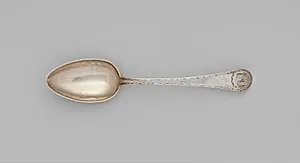
Spoon
ca. 1787
Medium
Silver
Dimensions
L. 8 in. (20.3 cm)
Classification
Spoon
Culture
American
Department
The American Wing
Museum
Metropolitan Museum of Art, New York, NY
Credit
Bequest of Alphonso T. Clearwater, 1933
Accession Number
33.120.397
Rights
Public Domain
Art Historical Context
This elegant silver spoon, crafted Paul Revere Jr. 1787, exemplifies the finest early American silversmithing. Measuring 8 inches in length, it hails from the workshop of the legendary patriot and artisan whose midnight ride warned of British advances during the Revolution. Revere, a master of the craft, transitioned from wartime heroism to producing luxury goods that rivaled European imports, marking America's emerging cultural independence. Silver spoons like this were more than utensils—they were status symbols for the new republic's elite, showcasing hand-hammered precision and subtle chasing techniques that highlighted the metal's luster. Revere's work often featured clean lines and functional beauty, reflecting Federal-style simplicity influenced by neoclassical tastes. As a bequest to the Metropolitan Museum of Art's American Wing in 1933, it preserves a tangible link to post-Revolutionary prosperity. Today, this spoon invites us to appreciate Revere's dual legacy: revolutionary spirit fused with artisanal excellence, a reminder of how everyday objects embodied the young nation's aspirations.
About the Artist
Paul Revere Jr. · 1734–1818
Paul Revere Jr. (1734–1818), born in Boston's North End, was the son of French Huguenot silversmith Apollos Rivoire—also known as Paul Revere Sr.—and Deborah Hichborn, a member of a local artisan family. At age 13, he left school to apprentice under his father, mastering the intricate craft of silversmithing and engraving in the family shop, which he inherited upon his father's death in 1754. Reve...