
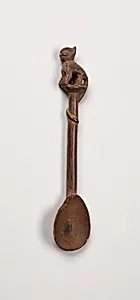
Spoon with Long-Tailed Puma on Handle
1450–1532
Medium
Wood
Dimensions
14.9 × 3.3 cm (5 7/8 × 1 5/16 in.)
Classification
wood
Department
Arts of the Americas
Museum
Art Institute of Chicago
Accession Number
91750
Rights
Public Domain
Art Historical Context
This exquisite wooden spoon, crafted by Inca artisans between 1450 and 1532, showcases the empire's masterful blend of functionality and symbolism. Measuring just 14.9 × 3.3 cm, its slender bowl flows into a handle crowned by a intricately carved long-tailed p—a fierce feline emblem of power and the natural world in Andean cosmology. Housed in the Art Institute of Chicago's of the Americas department, this artifact bridges the everyday and the sacred, likely used for serving food or ritual substances. During the height of the Inca Empire (c. 1438–1533), wood carving was a vital craft, though the Inca are often celebrated for stone masonry and goldwork. Here, the artist employed precise chiseling to capture the puma's dynamic form—its arched back, alert ears, and sinuous tail—infusing a simple utensil with vitality. Pumas symbolized earthly strength and imperial might, reflecting the Inca's deep harmony with their rugged Andean environment. This spoon offers a intimate glimpse into pre-Columbian life, highlighting how Inca objects elevated daily tools into cultural treasures. Visitors will appreciate its tactile warmth and enduring craftsmanship, a testament to an empire's artistic ingenuity just before European contact.
About the Artist
Inca
Inca artists, operating anonymously within the vast Inca Empire from approximately 1425 to 1532 CE, were masterful creators whose works symbolized imperial power and unity across the Andes. Thriving in the heart of Cuzco, the empire's capital, these skilled artisans—men and women alike—produced textiles, ceramics, and metalwork that served both practical and ceremonial purposes. Gifted craftspeopl...