
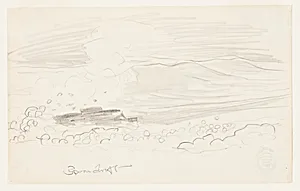
"Spoondrift," Heavy Sea, Prout's Neck
Classification
seascapes
Department
Smithsonian Collection
Museum
Smithsonian American Art Museum
Credit
Gift of Charles Savage Homer, Jr.
Accession Number
1912-12-207
Rights
Public Domain
About this artwork
Research in Progress
Art Historical Context
Winslow Homer’s “Spoondrift,” Heavy Sea, Prout’s Neck captures the dramatic power of the Atlantic Ocean near the artist’s home in Maine. Painted around 1909, late in Homer’s career, the work belongs to his renowned series of seascapes created at Prout’s Neck, where he lived from the 1880s onward. Homer turned increasingly to the sea as his primary subject, drawn to its raw energy and ever-changing moods. The title refers to “spoondrift,” the spray blown from wave crests by strong winds, hinting at the turbulent conditions depicted. Homer’s mature style distills nature’s force into bold, simplified forms that convey both movement and stillness. Though the exact medium remains undocumented, his late marine works often explore the tension between human presence and the vast, indifferent ocean. Acquired by the Smithsonian American Art Museum through a gift from the artist’s brother, Charles Savage Homer, Jr., the painting stands as a testament to Homer’s enduring fascination with the sea and his lasting influence on American art.