
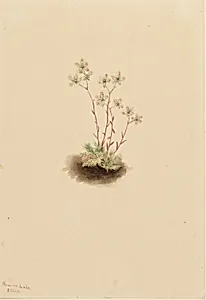
Spotted Saxifrage (Saxifraga bronchialis)
Medium
Painting
Classification
Painting
Department
Smithsonian Collection
Museum
Smithsonian American Art Museum
Credit
Smithsonian American Art Museum, Gift of the artist
Accession Number
1970.355.448
Rights
Public Domain
Tags
Art Historical Context
Mary Vaux Walcott'sSpotted SaxifrageSaxifraga bronch)*, painted in 1903, the delicate beauty of this alpine wildflower native to rocky mountain slopes. Rendered in watercolor—a medium Walcott mastered for its precision and luminosity—the painting showcases the plant's spotted leaves and clustered white blooms with scientific accuracy. Now part of the Smithsonian American Art Museum's, gifted by the artist herself, it her lifelong passion for documenting North America's flora. Walcott, a pioneering mountaineer, botanist, and artist (1860–1940), created hundreds of such works during summer expeditions in the Canadian Rockies alongside her husband, paleontologist Charles Doolittle Walcott. Active in the early 20th century, her illustrations bridged art and science, contributing to botanical studies at a time when field exploration was rare for women. Published later in her seminal book *North American Wild Flowers* (1925), these paintings highlight the era's growing fascination with natural history and conservation. This piece not only delights with its vivid realism but also invites visitors to appreciate the spotted saxifrage's resilience in harsh environments, symbolizing endurance in art and nature alike. A testament to Walcott's keen observation, it remains a treasured highlight in the Smithsonian's holdings.