
Spring
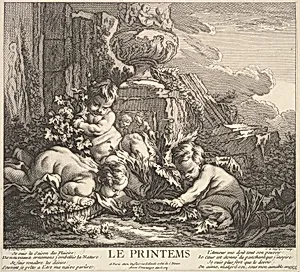
Medium
Etching and engraving
Dimensions
Sheet (trimmed): 8 3/4 × 9 5/8 in. (22.3 × 24.5 cm)
Classification
Prints
Department
Drawings and Prints
Museum
Metropolitan Museum of Art, New York, NY
Credit
Harris Brisbane Dick Fund, 1953
Accession Number
53.600.1038
Rights
Public Domain
Tags
Art Historical Context
"Spring," an exquisite etching and engraving from the18th century, captures the playful essence of the season through the collaboration of François Boucher, a master of Rococo elegance, and Claude Augustin Duos le Jeune, a skilled reproductive engraver. Created between 1735 and 1786, this print likely reproduces one of Boucher's whimsical designs, featuring frolicsome children embodying renewal and joy—hallmarks of Rococo's lighthearted, decorative style. Rococo art, flourishing in Louis XV's France, celebrated ornate beauty, mythology, and the senses, often personifying the seasons in idyllic vignettes. The medium of etching and engraving was revolutionary for its time, allowing intricate details to be precisely captured and widely disseminated. Etching involves acid biting into a metal plate for fluid lines, while engraving carves them manually for crisp definition, making Boucher's lush imagery accessible beyond oil paintings. At 8 3/4 × 9 5/8 inches (trimmed), this intimate sheet invites close viewing, highlighting the tactile charm of putti-like children amid budding motifs. Housed in The Metropolitan Museum of Art's Drawings and Prints department, acquired via the Harris Brisbane Dick Fund in 1953, "Spring" reflects printmaking's cultural role in democratizing high art. It evokes 18th-century delight in nature's cycle, reminding visitors of art's power to infuse everyday wonder with timeless grace.
About the Artist
Claude Augustin Duflos le Jeune|François Boucher (French|French|French) · 1700 |1703 |1700 –1786 |1770 |1786
French, Paris 1700–1786 Paris|French, Paris 1703–1770 Paris|French, Paris 1700–1786 Paris