
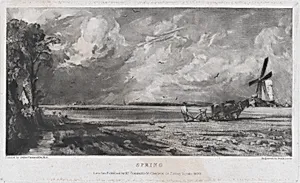
Spring
Medium
Mezzotint; third state of five
Dimensions
Image: 5 in. × 9 11/16 in. (12.7 × 24.6 cm) Plate: 6 1/8 × 10 1/8 in. (15.6 × 25.7 cm) Sheet: 11 5/8 × 17 1/4 in. (29.5 × 43.8 cm)
Classification
Prints
Department
Drawings and Prints
Museum
Metropolitan Museum of Art, New York, NY
Credit
Harris Brisbane Dick Fund, 1925
Accession Number
25.51.3
Rights
Public Domain
Tags
Art Historical Context
"Spring," a captivating mezzotint from 1830, showcases the masterful collaboration between English Romantic painter John Constable and engraver David Lucas. Created as the third state of five in's ambitious series *English Landscapes*, this print translates Constable's luminous oil sketch into a richly toned work depicting a serene pastoral scene. With its windmill, farmstead, horses, and expansive landscape bathed in soft spring light, it evokes the fleeting beauty of the English countryside—likely inspired by the Suffolk-Derbyshire border near Constable's beloved Dedham Vale. Mezzotint, a technique pioneered in the 17th century, was ideal for Constable's atmospheric effects, as its "black-ground" method allows for velvety depths and subtle gradations of light, rivaling oil painting. Lucas's progressive states reveal the painstaking refinement process, with this third version balancing detail and mood before final publication. Printed on a modest 5 × 9⅝-inch image, it made Constable's vision accessible to a wider audience during the Industrial Revolution, when nostalgia for rural life surged. Acquired by The Metropolitan Museum of Art through the Harris Brisbane Dick Fund in 1925, "Spring" exemplifies how prints democratized art, preserving Constable's revolutionary naturalism—his "skying" of clouds and truthful observation of nature—for generations of admirers. A window into 19th-century England's vanishing idyll.
About the Artist
David Lucas|John Constable · 1802–1881
**David Lucas (1802–1881)** David Lucas was born in 1802 in Geddington Chase, Northamptonshire, the son of a farmer.) A chance encounter in 1820 led him to become a pupil of the renowned engraver Samuel William Reynolds, under whom he apprenticed in London until 1827, mastering the art of mezzotint engraving.) By 1827, Lucas had published his first mezzotints, showcasing his precocious talent for...