
Spring
1643–44
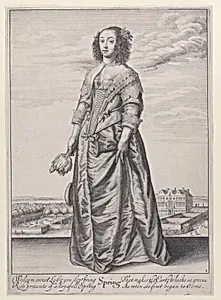
Medium
Etching; second state of two
Dimensions
Sheet: 10 1/2 × 7 1/2 in. (26.7 × 19 cm)
Classification
Prints
Department
Drawings and Prints
Museum
Metropolitan Museum of Art, New York, NY
Credit
Gift of Barbara E. Fox, in memory of Howard A. Fox MD, 2018
Accession Number
2018.846.1
Rights
Public Domain
Tags
Art Historical Context
Wenceslaus Hollar *Spring* (1643–44) is a delicate etching capturing the essence of renewal through the graceful figure of a woman, emblematic of the season. Created during Hollar's time in England, where he as an engraver for King Charles I this second state of two refinements to the plate, showcasing the artist's meticulous process. Measuring 10 1/2 × 7 1/2 inches, the print exemplifies Hollar's mastery of etching—a technique where acid etches lines into a metal plate for intricate, reproducible detail—allowing widespread dissemination of elegant imagery in the Baroque era. As a Bohemian artist renowned for his topographical views, portraits, and allegorical works, Hollar brought Continental precision to British art. *Spring* likely belongs to his series personifying the Four Seasons, blending classical motifs with naturalistic observation, a nod to Renaissance traditions while embracing 17th-century printmaking's rise. Its focus on a female figure highlights themes of femininity and fertility tied to the season, resonating in a period of political turmoil like the English Civil War. Acquired by the Metropolitan Museum of Art in 2018 as a gift from Barbara E. Fox, this print invites visitors to appreciate Hollar's technical virtuosity and the enduring allure of seasonal allegory in art.
About the Artist
Wenceslaus Hollar · 1607–1677
Wenceslaus Hollar (1607-1677) was a prolific Bohemian etcher who became one of the most accomplished printmakers of the seventeenth century. Born in Prague, he trained under Matthäus Merian in Frankfurt before entering the service of Thomas Howard, Earl of Arundel, in 1636. Hollar spent most of his career in England, where he produced approximately 2,740 etchings documenting an extraordinary range...