
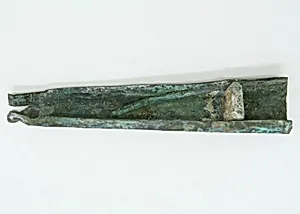
Spring Device
Unknown Artist
13th century
Medium
Bronze
Dimensions
L. 4 1/2 in. (11.4 cm)
Classification
Miscellaneous
Culture
possibly French, possibly German
Department
Arms and Armor
Museum
Metropolitan Museum of Art, New York, NY
Credit
Gift of Clarence H. Mackay, Archer M. Huntington, Stephen H. P. Pell and Bashford Dean, 1928
Accession Number
28.99.53
Rights
Public Domain
Art Historical Context
Nestled in the Metropolitan Museum of Art's Arms and Armor Department, the *Spring Device* is a compact bronze artifact from the 13th century, measuring just 4½ inches (11.4 cm) in length. Crafted by an unknown artist, possibly from France or Germany, this enigmatic piece falls under the "Miscellaneous" classification, hinting at its role as a functional component rather than a standalone weapon or armor. Donated in 1928 by prominent collectors including Bashford Dean, it exemplifies the exquisite metalwork of medieval Europe. In the High Middle Ages, such devices were vital to the era's advancing mechanical ingenuity, likely serving as a tension spring for crossbows, locks, or clasps in armor. Bronze, prized for its durability and corrosion resistance, allowed for precise casting and tempering, showcasing the sophisticated lost-wax techniques of the time. This small object reflects the intersection of artistry and engineering during a period of chivalric warfare and Gothic innovation, where even utilitarian parts demanded masterful craftsmanship. Though its exact function remains a tantalizing mystery, the *Spring Device* invites us to ponder the hidden mechanics behind medieval might—reminding visitors that behind every suit of armor lay countless such uncelebrated innovations. A true gem for enthusiasts of history's unsung hardware!