
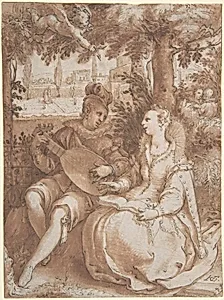
Spring, Drawing for Engraving of the Same Subject
ca. 1594
Medium
Pen and brown ink, brush and red-brown wash, with traces of oxidized white lights
Dimensions
Overall: 7 5/8 x 5 11/16in. (19.4 x 14.5cm)
Classification
Drawings
Department
Drawings and Prints
Museum
Metropolitan Museum of Art, New York, NY
Credit
Rogers Fund, 1961
Accession Number
61.25.1
Rights
Public Domain
Tags
Art Historical Context
Created around 1594 by the renowned Dutch artist Hendrick Goltzius, this delicate preparatory drawing captures the lively spirit of spring through an intimate scene of couples, men, and women gathered with lutes. Goltzius, celebrated as one of the greatest printmakers of the Northern Renaissance, designed the work as a model for an engraving, translating the fluid energy of pen and ink into a reproducible image that would reach wide audiences across Europe. The medium—pen and brown ink with red-brown washes—reveals Goltzius’s masterful draftsmanship, where subtle tonal gradations and highlights guide the engraver’s burin to suggest light, texture, and movement. At just under eight inches tall, the drawing’s intimate scale belies its ambitious role in bridging painting, drawing, and printmaking during a period when reproductive prints were transforming how art was shared and appreciated. As part of a likely series on the Four Seasons, the work reflects late-sixteenth-century interests in allegory, nature’s cycles, and the pleasures of music and courtship. Today it offers visitors a rare glimpse into an artist’s creative process at the Metropolitan Museum of Art.
About the Artist
Hendrick Goltzius · 1558–1617
Hendrick Goltzius (1558–1617) was the most celebrated engraver of the Northern Renaissance and a pivotal figure in Dutch Mannerism. Born near the German-Dutch border, Goltzius transformed printmaking into a virtuoso art form through his revolutionary 'swelling line' technique, where the burin was manipulated to create lines of varying thickness that produced unprecedented tonal effects and three-d...