
Square Panel
Roman period (30 BCE– 641 CE), 5th/6th century
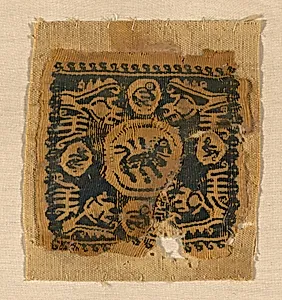
Medium
Wool, tapestry weave
Dimensions
10 × 10.2 cm (3 7/8 × 4 in.)
Classification
textile
Department
Textiles
Museum
Art Institute of Chicago
Accession Number
93036
Rights
Public Domain
Art Historical Context
This delicate Square Panel, a masterpiece of Coptic textile art from 5th- or 6th-century Egypt during the late Roman period (30 BCE–641 CE exemplifies the vibrant craftsmanship of early Christian communities in the Nile Valley. Produced by Coptic artisans—members of Egypt's native Christian population—these small woven fragments were often integrated into garments, hangings, or cushions, serving both practical and decorative purposes. At just 10 × 10.2 cm, this square panel highlights the precision of ancient weavers working in a multicultural hub blending Greco-Roman, Pharaonic, and emerging Byzantine influences. Crafted in wool using the tapestry weave technique, the panel features double-cloth interlacing where colored weft yarns create vivid patterns against a structured warp. This labor-intensive method, prized for its durability and colorfastness, allowed Coptic artists to depict motifs like animals, hunts, or floral designs—symbols of daily life, fertility, and spiritual themes. Wool's availability from local sheep made it ideal for these richly hued works, which survived burial in Egypt's arid sands. Housed in the Art Institute of Chicago's Textiles Department, this panel offers a window into Coptic cultural resilience amid Roman rule and Islamic conquests looming by 641 CE. Its survival underscores the artistry of a marginalized yet innovative tradition, bridging antiquity and the medieval world.
About the Artist
Coptic
Coptic, the collective attribution for anonymous masters of early Christian Egypt, embodies the vibrant fusion of pharaonic, Hellenistic, and Greco-Roman traditions that defined art from the 4th century onward. Emerging in the context of Coptic Christianity's rise after the 1st century AD, these artists operated amid economic constraints that favored functional craftsmanship over elite patronage, ...