
Squaring Logs (Homme que fend des buches)
1826 to 1850
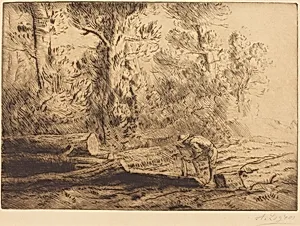
Medium
etching and drypoint in brown ink
Classification
Department
CG-E
Museum
National Gallery of Art, Washington, D.C.
Credit
Gift of George Matthew Adams in memory of his mother, Lydia Havens Adams
Accession Number
1952.10.74
Rights
Public Domain
Art Historical Context
**Squaring Logs (Homme fend des bûches by Alphonse Leg captures the raw physicality rural labor in 19-century France. Created between 1826 and 1850 using etching and drypoint in warm brown ink, this print depicts a woodsman intently splitting logs, embodying the Realism movement Legros championed alongside artists like Gustave Courbet. Born in France in 1837, Legros bridged French and British art scenes, later becoming a professor at the Slade School in London, he elevated printmaking as a fine art form accessible to wider audiences. The etching technique—where acid etches lines into a metal plate—combines with drypoint's direct, scratched burrs to produce rich, velvety textures that convey the axe’s sharp bite and wood’s fibrous grain. Printed in brown ink, it evokes the earthy tones of the forest, highlighting Legros's mastery in translating three-dimensional toil into intimate, monochromatic drama. Prints like this were vital in the era, allowing detailed studies of everyday life to reach collectors beyond oil paintings. Today, this work resides in the National Gallery of Art, a gift from George Matthew Adams in memory of his mother, Lydia Havens Adams. It invites visitors to appreciate the dignity in manual labor, a hallmark of Realist ethos, reminding us of art's power to honor the unsung rhythms of human endeavor.
About the Artist
Alphonse Legros · 1837–1911
Alphonse Legros (1837–1911) was born in Dijon, France, and trained in Paris at the drawing school of Horace Lecoq de Boisbaudran, whose unconventional teaching method — which emphasised memory drawing and acute observation over academic convention — would leave a lasting mark on Legros's practice. At Lecoq's school he formed friendships with Jules Dalou and Auguste Rodin that endured throughout hi...