
St. Agnes
c. 1470-1490
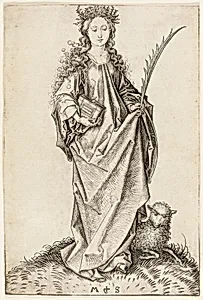
Medium
Engraving on paper
Dimensions
15.2 × 10.3 cm (6 × 4 1/16 in.)
Classification
engraving
Department
Prints and Drawings
Museum
Art Institute of Chicago
Accession Number
3936
Rights
Public Domain
Art Historical Context
Martin Schongauer’s *St. Agnes*, created around 1470–1490, captures the gentle dignity of one of Christianity’s early martyrs. The young saint is traditionally shown with a lamb, symbolizing both her purity and her name, which echoes the Latin word for lamb. Working in the late Gothic period just as the Northern Renaissance was emerging, Schongauer brought a refined sensitivity to religious subjects, making them feel both intimate and spiritually resonant. This small engraving, measuring only 15.2 × 10.3 cm, highlights the revolutionary power of printmaking in the fifteenth century. Engraving on paper allowed images to travel widely beyond church walls and wealthy collectors, reaching devout households across Europe. Schongauer’s precise lines and delicate modeling demonstrate the medium’s capacity for fine detail and tonal subtlety, qualities that made his prints highly sought after and influential for later artists. Housed in the Art Institute of Chicago’s Prints and Drawings collection, *St. Agnes* offers modern viewers a window into late-medieval devotional life. Its compact size suggests it may have served as a personal aid to prayer, combining artistic beauty with quiet spiritual encouragement.
About the Artist
Martin Schongauer · 1435–1491
Martin Schongauer, born around 1450–1453 in Colmar, Alsace, emerged from a family of skilled artisans. The third of four or five sons of goldsmith Caspar Schongauer, who had relocated from Augsburg to Colmar around 1440, Martin was immersed in the goldsmith's trade from youth, likely receiving his initial training in his father's workshop—a common path for early engravers. He further honed his ski...