
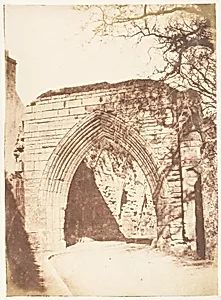
St. Andrews. The Pends
Medium
Salted paper print from paper negative
Classification
Photographs
Department
Photographs
Museum
Metropolitan Museum of Art, New York, NY
Credit
Harris Brisbane Dick Fund, 1937
Accession Number
37.98.1.14
Rights
Public Domain
Tags
Art Historical Context
Step through the ancient stone arches of St. Andrews' Pends in this evocative salted paper print by pioneering photographers David Octavius Hill and Robert Adamson, created between 1843 and 1847. Nestled in the historic Scottish town of St. Andrewsonce the ecclesiastical capital of Scotland—this 12th-century gatehouse, known as "The Pends," served as a dramatic entrance to the cathedral precinct. Hill and Adamson masterfully capture its weathered grandeur, with towering arches framing a glimpse of everyday life, evoking the romance of medieval architecture amid the misty Scottish light. As early masters of the calotype process—invented by William Henry Fox Talbot—this duo printed from paper negatives onto salted paper, yielding soft, painterly tones rich in texture and depth. Unlike sharp daguerreotypes, calotypes allowed multiple prints from a single negative, revolutionizing photography's artistic potential. Their partnership, one of the first dedicated to the medium, produced over 2,500 images, blending Hill's painterly eye with Adamson's technical prowess during Scotland's vibrant 1840s cultural scene. Housed in The Metropolitan Museum of Art's Photographs Department (Harris Brisbane Dick Fund, 1937), this work exemplifies how 19th-century innovators preserved vanishing heritage, inviting us to ponder time's gentle erosion on enduring stone. A testament to photography's dawn, it bridges art and history for modern eyes.
About the Artist
David Octavius Hill|Robert Adamson|Hill and Adamson · 1802–1870
David Octavius Hill (1802–1870) was a Scottish painter, photographer, and arts administrator whose pioneering photography partnership with Robert Adamson from 1843 to 1847 transformed the medium into an art form. Born in Perth and trained in Edinburgh, Hill established himself as a landscape painter and became secretary of the Royal Scottish Academy, a position he held for nearly forty years. His ...