
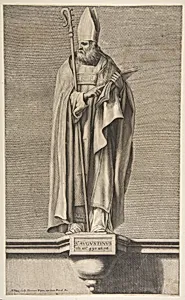
St. Augustine
Medium
Engraving with etching
Dimensions
sheet: 18 x 10 15/16 in. (45.7 x 27.8 cm)
Classification
Prints
Department
Drawings and Prints
Museum
Metropolitan Museum of Art, New York, NY
Credit
Harris Brisbane Dick Fund, 1953
Accession Number
53.600.270(6)
Rights
Public Domain
Tags
Art Historical Context
This striking engraving, *St. Augustine*, showcases the collaborative talents of French Baroque painter Laurent de La Hyre, alongside engravers Herman Weyen and Pitau. Dated undated (n.d.), it captures the revered 4th-century saint and theologian, a pivotal figure in Christian history known for his writings like *Confessions* and *City of God Such depictions were common in 17th Europe, blending reverence for saints with the era's emphasis on dramatic religious imagery to inspire faith among the faithful. Crafted in engraving with etching—a meticulous printmaking technique where lines are incised into a metal plate and inked for multiple impressions—this work measures an impressive 18 x 10 15/16 inches (45.7 x 27.8 cm). Etching allowed for fluid, expressive lines that mimicked painting's subtlety, making high-quality reproductions accessible beyond original canvases. This method democratized art, spreading Baroque ideals of grandeur and emotion through prints collected by scholars and devotees alike. Housed in the Metropolitan Museum of Art's Drawings and Prints department, acquired via the Harris Brisbane Dick Fund in 1953, *St. Augustine* exemplifies the cultural role of prints in preserving saintly icons. Visitors can appreciate how it bridges painting and devotion, inviting reflection on enduring spiritual legacies.
About the Artist
Laurent de La Hyre|Herman Weyen|Nicolas Pitau · 1606–1656
Laurent de La Hyre (1606–1656) was a French painter whose elegant, classical compositions placed him among the finest artists of the first generation of French Baroque painters working in Paris. Born into an artistic family — his father Étienne de La Hyre was also a painter — Laurent received his early training largely through independent study rather than formal apprenticeship under a single domi...