
St. Bartholomew
1470–1491
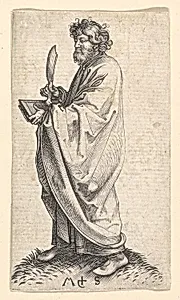
Medium
Engraving
Dimensions
Sheet: 3 7/16 in. × 2 in. (8.8 × 5.1 cm)
Classification
Prints
Department
Drawings and Prints
Museum
Metropolitan Museum of Art, New York, NY
Credit
Harris Brisbane Dick Fund, 1928
Accession Number
28.97.102
Rights
Public Domain
Tags
Art Historical Context
Martin Schongauer's *St. Bartholomew* (ca. 1470–1491) is a masterful engraving from the Northern Renaissance, capturing the apostle saint in a compact sheet measuring just 3 7/16 × 2 inches. As one of the earliest and most influential German engravers, Schongauer depicts the martyr—traditionally shown with a knife, symbolizing his flaying and possibly a book representing sacred texts—rendering fine details that invite close inspection. This print, now in the Metropolitan Museum of Art's Drawings and Prints department, exemplifies the era's shift toward portable, reproducible religious imagery. Schongauer's technique shines in his precise use of line work, creating texture, depth, and dramatic light through cross-hatching and stippling on a copper plate. Active in Colmar and Ulm, he bridged Gothic traditions with emerging Renaissance naturalism, influencing later masters like Albrecht Dürer. Engravings like this allowed widespread devotion, as affordable prints circulated among pilgrims and collectors, democratizing art beyond altarpieces. Culturally, such saintly portraits reinforced Catholic iconography during a time of religious fervor, blending piety with artistic innovation. Acquired via the Harris Brisbane Dick Fund in 1928, this gem highlights Schongauer's legacy as a printmaking pioneer, perfect for contemplating faith's visceral intensity up close.
About the Artist
Martin Schongauer · 1435–1491
Martin Schongauer, born around 1450–1453 in Colmar, Alsace, emerged from a family of skilled artisans. The third of four or five sons of goldsmith Caspar Schongauer, who had relocated from Augsburg to Colmar around 1440, Martin was immersed in the goldsmith's trade from youth, likely receiving his initial training in his father's workshop—a common path for early engravers. He further honed his ski...