
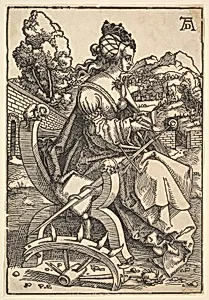
St. Catherine
Medium
Woodcut; second of two states
Dimensions
Sheet: 9 7/16 × 6 7/16 in. (23.9 × 16.3 cm)
Classification
Prints
Department
Drawings and Prints
Museum
Metropolitan Museum of Art, New York, NY
Credit
Rogers Fund, 1918
Accession Number
18.17.2-35
Rights
Public Domain
Tags
Art Historical Context
Hans Baldung Grien (c. 1484/85–1545), a leading German artist of the Northern Renaissance and close associate of Albrecht Dürer, createdSt. Catherine* around 1505. This woodcut, in its second state, exemplifies early 16th-century printmaking techniques, where the artist carved intricate designs into wooden blocks for inking and pressing onto paper. Measuring just 9 7/16 × 6 7/16 inches, it was produced during Baldung's formative years in Nuremberg, blending late Gothic expressiveness with emerging Renaissance clarity. The image depicts St. Catherine of Alexandria, a revered Christian martyr and virgin saint, often symbolized by the spiked breaking wheel from which she miraculously survived before her beheading. Woodcuts like this were vital for disseminating religious imagery to a wide audience in pre-Reformation Europe, making devotional art accessible beyond elite paintings. Baldung's dynamic composition, with bold lines and dramatic contrasts, showcases his mastery of the medium—refinements in the second state likely enhanced details or shading for greater depth. Acquired through the Rogers Fund in 1918, this print from the Metropolitan Museum of Art's Drawings and Prints collection highlights Baldung's innovative style, foreshadowing his later fascination with mysticism and the macabre. Visitors will appreciate its technical precision and the saint's poised elegance, a testament to faith's enduring visual power.
About the Artist
Hans Baldung (called Hans Baldung Grien) · 1484–1545
Hans Baldung Grien (1484/85–1545), born in Schwäbisch Gmünd into an erudite family of jurists and physicians, forsook academia to pursue art. His early training around 1500 took place in the Upper Rhineland, likely Strasbourg, before he apprenticed under Albrecht Dürer in Nuremberg from 1503 to 1507. There, the young artist honed his skills in painting, printmaking, and stained glass, even managin...