
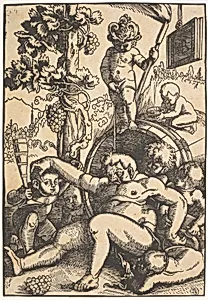
The Drunk Bacchus
Medium
Woodcut; second of two states
Dimensions
Sheet: 8 11/16 × 5 15/16 in. (22 × 15.1 cm)
Classification
Prints
Department
Drawings and Prints
Museum
Metropolitan Museum of Art, New York, NY
Credit
Harris Brisbane Dick Fund, 1927
Accession Number
27.54.7
Rights
Public Domain
Tags
Art Historical Context
Behold *The Drunk Bacchus a captivating woodcut by the German Renaissance artist Hans Bald Grien, created around 1520. Baldung, a protégé of Albrecht Dürer was renowned for his bold, expressive prints that often delved into themes of sensuality, mortality, and excess. This work, in its second state—a refined edition of the original block—measures a compact 8 11/16 × 5 15/16 inches, making it an intimate yet powerful piece from the Metropolitan Museum of Art's Drawings and Prints collection, acquired through the Harris Brisbane Dick Fund in 1927. The image portrays Bacchus, the Roman god of wine, in a state of inebriated revelry, surrounded by elements evoking drunkenness and youthful exuberance, including boys in playful disarray. Woodcuts like this were revolutionary in the Northern Renaissance, allowing for intricate details carved into wood blocks and printed in multiples, democratizing art for a wider audience beyond elite patrons. Baldung's masterful line work captures dynamic poses and textured shading, heightening the scene's erotic and chaotic energy. Culturally, this print reflects early 16th-century fascination with classical mythology amid the Reformation's moral tensions, blending pagan indulgence with Gothic intensity. It's a vivid reminder of how artists like Baldung used prints to provoke thought on vice and vitality, inviting viewers to ponder the intoxicating blur between divine ecstasy and human folly.
About the Artist
Hans Baldung (called Hans Baldung Grien) · 1484–1545
Hans Baldung Grien (1484/85–1545), born in Schwäbisch Gmünd into an erudite family of jurists and physicians, forsook academia to pursue art. His early training around 1500 took place in the Upper Rhineland, likely Strasbourg, before he apprenticed under Albrecht Dürer in Nuremberg from 1503 to 1507. There, the young artist honed his skills in painting, printmaking, and stained glass, even managin...