
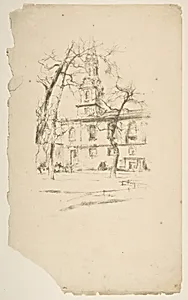
St. Giles-in-the-Fields
Medium
Transfer lithograph with stumping; only state (Chicago); printed in black ink on cream laid paper removed from an old ledger
Dimensions
Image: 8 9/16 × 5 9/16 in. (21.7 × 14.2 cm) Sheet: 13 3/8 × 8 1/16 in. (34 × 20.4 cm)
Classification
Prints
Department
Drawings and Prints
Museum
Metropolitan Museum of Art, New York, NY
Credit
Harris Brisbane Dick Fund, 1917
Accession Number
17.3.250
Rights
Public Domain
Tags
Art Historical Context
James McNeill Whistler, renowned American-born artist associated with the Aesthetic movement, captures the serene silhouette of St. Giles-in-Fields, a historic church in London's West End, in this 1896 transfer lith. Printed in black ink on cream laid paper salvaged from an old ledgeradding a touch of archival whimsy—the image measures just 8 9/16 × 5 9/16 inches, inviting intimate contemplation. Whistler's late-career print showcases his mastery of subtle tones and atmospheric effects, evoking the misty urban landscapes he loved, much like his famous Thames etchings. The technique of transfer lithography, where the artist draws on paper that is then transferred to a lithographic stone, allowed Whistler to achieve painterly softness. He enhanced this with stumping—a blending tool typically used in charcoal drawing—to create velvety shadows among the church's spire, trees, and rooftops. This sole "Chicago" state impression highlights the rarity of Whistler's prints, which bridged fine art and reproduction, influencing modern graphic arts. Acquired through the Harris Brisbane Dick Fund in 1917 for the Metropolitan Museum of Art's Prints collection, *St. Giles-in-the-Fields* reflects Whistler's philosophy of "art for art's sake," distilling everyday architecture into harmonious poetry. Visitors, linger here to feel the hush of a London evening.
About the Artist
James McNeill Whistler · 1834–1903
James Abbott McNeill Whistler (1834-1903) was an American-born painter and printmaker who became a leading figure in the Aesthetic Movement and pioneer of Tonalism and Japonisme. He revolutionized art by championing "art for art's sake" and treating paintings as visual equivalents of musical compositions, titling works as "arrangements," "harmonies," and "nocturnes" to emphasize formal qualities o...