
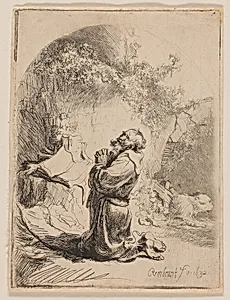
St. Jerome Praying: Arched
Medium
Etching and drypoint on paper
Dimensions
Plate/image: 10.9 × 8.1 cm (4 5/16 × 3 1/4 in.); Sheet: 11.2 × 8.4 cm (4 7/16 × 3 5/16 in.)
Classification
etching
Department
Prints and Drawings
Museum
Art Institute of Chicago
Accession Number
29245
Rights
Public Domain
Art Historical Context
In the hallowed tradition of Baroque artistry, Rembrandt van Rijn's *St. Jerome Praying: Arched* (1632) captures the Dutch master's profound spirituality through intimate printmaking. This small etching and drypoint on paper—measuring just 10.9 × 8.1 cm—depicts the revered Church Father St. Jerome in deep contemplation, likely amid his scholarly penance in the desert, a motif symbolizing devotion and introspection. Created early in Rembrandt's career, as he rose to fame in Amsterdam during the Dutch Golden Age, the work reflects the era's fervent religious humanism amid Protestant Reformation influences. Rembrandt's genius shines in his masterful etching and drypoint techniques, where acid-etched lines blend with the burr-rich textures of drypoint for velvety shadows and dramatic chiaroscuro. The arched composition, evoking a window into the divine, heightens the sense of enclosure and focus, drawing viewers into Jerome's private prayer. These prints were revolutionary, allowing Rembrandt to experiment with light and texture beyond painting, producing editions that spread his vision across Europe. Housed in the Art Institute of Chicago's Prints and Drawings Department, this gem underscores Rembrandt's enduring legacy as a printmaker who elevated etching to fine art, inviting us to ponder faith's quiet intensity in an age of turmoil.
About the Artist
Rembrandt van Rijn · 1606–1669
Rembrandt Harmenszoon van Rijn (1606–1669) stands as one of the greatest visual artists in the history of Western art and the most important Dutch painter of the 17th century. Born in Leiden to a prosperous miller's family, Rembrandt transformed painting through his revolutionary use of light and shadow, his psychological depth in portraiture, and his elevation of etching to a fine art. His approx...