
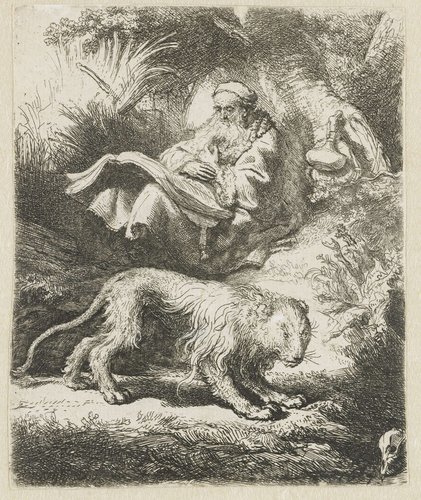
St Jerome reading
Medium
etching
Dimensions
89; 108
Rights
Public Domain
About this artwork
ets
Art Historical Context
In 1634, Rembrandt van R, the Dutch Baroque master renowned for his dramatic use of light and shadow (chiaroscuro), created *St Jerome Reading*, a intimate etching measuring just 108mm by 89mm. This small-scale print captures the fourth-century saint and scholar Jerome in a moment of quiet contemplation, poring over a book—likely evoking his legendary translation of the Bible into Latin, the Vulgate. At age 28, Rembrandt was establishing himself in Amsterdam, and this work reflects his early experimentation with etching, a technique he would perfect to rival his paintings in emotional depth and tonal richness. Etching allowed Rembrandt to reach a broader audience beyond wealthy patrons, as prints were more affordable and reproducible. Here, he employs a fine aquatint-like burr from drypoint to build velvety textures and subtle gradations, making the saint's furrowed brow and flowing robes leap from the page despite the modest copper plate. The composition's intimacy invites viewers into Jerome's scholarly world, blending spiritual reverence with human vulnerability—a hallmark of Rembrandt's empathetic style. This gem showcases Rembrandt's printmaking genius during his formative years, bridging Renaissance devotionals and Baroque intensity, and remains a testament to how a tiny etching can convey profound narrative power.
About the Artist
Rembrandt van Rijn · 1606–1669
Rembrandt Harmenszoon van Rijn (1606–1669) stands as one of the greatest visual artists in the history of Western art and the most important Dutch painter of the 17th century. Born in Leiden to a prosperous miller's family, Rembrandt transformed painting through his revolutionary use of light and shadow, his psychological depth in portraiture, and his elevation of etching to a fine art. His approx...