
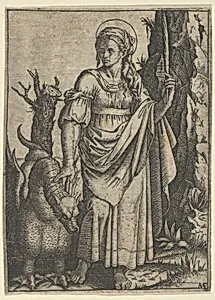
St Margaret holding a palm in her raised left hand, a dragon at her right
ca. 1500–1510
Medium
Engraving
Dimensions
4 1/4 x 4 5/8 in. (10.8 x 11.8 cm)
Classification
Prints
Department
Drawings and Prints
Museum
Metropolitan Museum of Art, New York, NY
Credit
The Elisha Whittelsey Collection, The Elisha Whittelsey Fund, 1948
Accession Number
48.176.2
Rights
Public Domain
Tags
Art Historical Context
In the early 16th century, around 1500–1510, Italian engraver Marcantonioondi collaborated with painter Francesco Francia to create this striking engraving depicting St. Margaret of, a beloved Christian saint and martyr. Measuring just 4¼ x 4⅝ inches, the intimate scale belies its powerful imagery: the saint stands triumphantly, palm frond of martyrdom raised in her left hand, a defeated dragon coils at her feet to the right—symbolizing her legendary triumph over Satan, who appeared as a dragon during her imprisonment. St. Margaret's story, popularized in medieval legends like the *Golden Legend*, made her a patron saint of pregnancy and childbirth, invoked against demonic forces. This print reflects the Renaissance fascination with classical antiquity and religious devotion, blending Francia's Bolognese style—known for its graceful figures and detailed landscapes—with Raimondi's masterful engraving techniques. Raimondi, a pioneer in reproductive printmaking, used fine burin lines to achieve tonal depth and texture, making high-art images accessible beyond elite patrons. Housed in the Metropolitan Museum of Art's Drawings and Prints department, this work exemplifies how engravings democratized sacred art during the High Renaissance, bridging painting and mass reproduction while celebrating female spiritual strength.
About the Artist
Marcantonio Raimondi|Francesco Francia · 1475–1534
Marcantonio Raimondi (c. 1480–1534), born near Bologna, Italy, emerged as one of the Renaissance's premier engravers, revolutionizing printmaking through his mastery of reproductive techniques. He trained in the workshop of the goldsmith, painter, and niellist Francesco Francia, whose influence is evident in his early engravings, such as the goldsmith-like shading in *Pyramus and Thisbe* (1505), h...