
St. Mark
1615–42
Medium
Etching
Dimensions
Sheet: 5 5/16 x 7 5/16 in. (13.5 x 18.5cm) Plate: 4 9/16 x 6 11/16 in. (11.6 x 17cm)
Classification
Prints
Department
Drawings and Prints
Museum
Metropolitan Museum of Art, New York, NY
Credit
Harris Brisbane Dick Fund, 1928
Accession Number
28.91.24
Rights
Public Domain
Tags
Art Historical Context
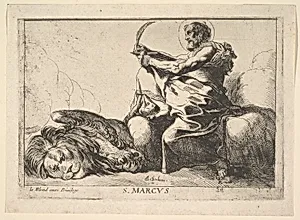
Behold *St. Mark*, a delicate etching by the French artist Pierre Brébiette, created sometime between 1615 and 1642. This intimate print captures the evangelist Saint Mark, one of the four Gospel authors in Christian tradition, often depicted with his symbolic lion—a fierce yet protective emblem of his apostolic strength and divine inspiration. Measuring just over 5 by 7 inches, the sheet invites close contemplation, revealing Brébiette's skill in rendering sacred figures with a sense of quiet reverence. Etching, the medium here, was a revolutionary intaglio technique in the early 17th century, where the artist scratches through a wax ground on a copper plate, allowing acid to etch fine, fluid lines. This method enabled Brébiette to achieve intricate details and expressive textures far beyond woodcuts, making prints like this accessible for devotional use or collectors. Housed in the Metropolitan Museum of Art's Drawings and Prints department, it exemplifies French printmaking during a time of artistic innovation amid the Baroque era's spiritual fervor. As part of the Harris Brisbane Dick Fund acquisition in 1928, *St. Mark* offers a window into Counter-Reformation piety, where images of saints reinforced faith and artistry. Visitors will appreciate its historical charm and the lion's watchful gaze—a timeless nod to resilience and revelation.
About the Artist
Pierre Brebiette · 1598–1642
Pierre Brébiette (c. 1598–c. 1642) was a French painter and etcher whose elegant, sensuous treatment of classical mythology and allegory earned him a significant reputation in early seventeenth-century Paris. Born in Mantes-sur-Seine, Brébiette traveled to Italy as a young man and lived and worked in Rome from around 1617 to approximately 1625, absorbing the influences of ancient sculpture, Renais...