
St. Osyth's Priory
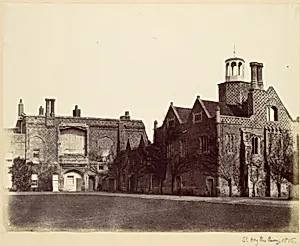
Medium
Albumen silver print from paper negative
Dimensions
21.1 x 27.2 cm. (8 5/16 x 10 11/16 in.)
Classification
Photographs
Department
Photographs
Museum
Metropolitan Museum of Art, New York, NY
Credit
Gift of Paul F. Walter, in memory of Christopher Hemphill, 1987
Accession Number
1987.1183.67
Rights
Public Domain
Tags
Art Historical Context
Alfred Capel Cure's *St. Osyth's Priory* (1856) captures the majestic ruins of this historic English religious house in Essex, showcasing its Gothic arches and weathered stonework against a serene landscape. Cure, a pioneering British photographer specialized in architectural subjects during the 1850s, using his lens to document vanishing medieval heritage amid rapid industrialization. This albumen silver print, measuring 21.1 x .2 cm, invites viewers to appreciate the priory's timeless grandeur, evoking a sense of quiet reverence for Britain's architectural past. Printed from a paper negative—a hallmark of the calotype process invented by William Henry Fox Talbot—the image exemplifies early photographic innovation. Albumen, derived from egg whites, coated the paper to produce sharp, luminous tones with rich detail, allowing multiple prints from a single negative. This technique was revolutionary, enabling photographers like Cure to preserve intricate building facades faithfully, far surpassing earlier daguerreotypes in reproducibility and scale. Housed in The Metropolitan Museum of Art's Photographs Department, this work highlights photography's role in 19th-century cultural preservation. Gifted in 1987, it reminds us how Cure's precise compositions bridged art and documentation, offering modern visitors a window into a bygone era of monastic life and ecclesiastical splendor.
About the Artist
Alfred Capel Cure · 1826–1896
Alfred Capel Cure (1826–1896) was a British artist whose career unfolded during the Victorian era, a period of remarkable diversity and ambition in British art. Active in a landscape tradition shaped by the achievements of John Constable and J.M.W. Turner, Cure worked at a time when watercolor and drawing held an especially prominent place in English artistic culture, embraced both by professional...