
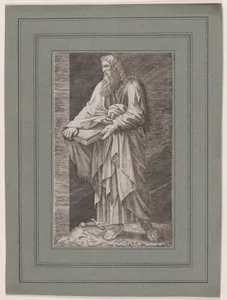
St. Paul (after Lombard)
1530–76
Medium
Engraving
Dimensions
sheet: 7 13/16 x 4 3/4 in. (19.8 x 12.1 cm)
Classification
Prints
Department
Drawings and Prints
Museum
Metropolitan Museum of Art, New York, NY
Credit
Gift of Georgiana W. Sargent, in memory of John Osborne Sargent, 1924
Accession Number
24.63.2046
Rights
Public Domain
Art Historical Context
Created by the Flemish engraver Lambert Suavius between 1530 and 1576, this small yet finely detailed print depicts Saint Paul after a design by the Liège artist Lambert Lombard. Measuring just under eight inches in height, the engraving exemplifies the reproductive printmaking practices that flourished during the Renaissance, when artists translated paintings and drawings into portable engravings that could circulate widely across Europe. Suavius’s precise line work captures the saint’s contemplative expression and flowing robes, demonstrating the medium’s ability to convey both texture and depth through delicate hatching and cross-hatching. Such prints played a vital role in disseminating religious imagery and artistic ideas during the Reformation era, allowing viewers far from major centers to encounter works by leading masters. Acquired by the Metropolitan Museum in 1924 as a gift from Georgiana W. Sargent, this impression preserves a moment when engraving bridged the worlds of painting and print, making devotional subjects like Saint Paul accessible to a broader audience.
About the Artist
Lambert Suavius · 1510–1576
Lambert Suavius (c.1510–c.1574/76), whose Flemish family name was Zutman, was born in Liège, in the southern Netherlands. He was the son of an episcopal goldsmith, Henri Zutman, and from his father's craft environment he inherited a training in the precise handling of metal and an appreciation for fine detail work. He became closely associated with his brother-in-law Lambert Lombard, the leading a...