
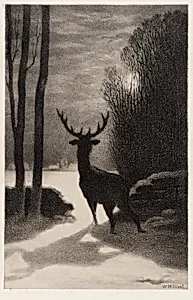
Stag in the Moonlight
ca. 1857
Medium
Graphic Arts-Print
Classification
Graphic Arts-Print
Department
Smithsonian Collection
Museum
Smithsonian American Art Museum
Credit
Smithsonian American Art Museum, Museum purchase
Accession Number
1979.27
Rights
Public Domain
Tags
Art Historical Context
William Morris Hunt’s “Stag in the Moonlight,” created around 1857, captures a solitary deer standing in a wintry forest beneath a luminous moon. As a graphic arts print, the work belongs to a medium that allowed artists to share evocative images with a broad audience through lithography or etching. The Smithsonian American Art Museum acquired the piece for its permanent collection, underscoring its value as an early example of American printmaking that blends observation and atmosphere. Hunt, who trained in Europe and helped introduce the Barbizon approach to the United States, favored subjects drawn directly from nature. Here the tags—deer, moon, forest, winter, night—suggest a quiet nocturne in which light and shadow create a sense of stillness and mystery. The print’s modest scale and tonal subtlety invite viewers to pause and experience the hushed drama of the natural world. Such images resonated in mid-nineteenth-century America, when expanding urban audiences sought reminders of wilderness and solitude. By rendering the stag in moonlight, Hunt transforms an ordinary woodland moment into a meditation on beauty, transience, and the quiet grandeur of the American landscape.
About the Artist
William Morris Hunt · 1824–1879
American, Brattleboro, Vermont 1824–1879 Appledore, New Hampshire