
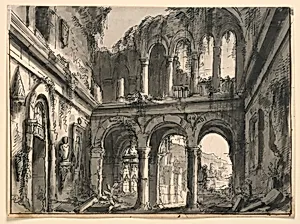
Stage Design, Interior of Ruined Renaissance Palace
early 19th century
Classification
theater
Department
Smithsonian Collection
Museum
Smithsonian American Art Museum
Credit
Museum purchase through gift of various donors and from Eleanor G. Hewitt Fund
Accession Number
1938-88-264
Rights
Public Domain
About this artwork
Research in Progress
Art Historical Context
Romolo Achille Liverani’s “Stage Design, Interior of Ruined Renaissance Palace” captures the dramatic atmosphere typical of early nineteenth-century theater. Created by the Italian artist (1809–1872), this work reflects the period’s fascination with Romantic themes of decay and nostalgia, transforming the grandeur of Renaissance architecture into a haunting, fragmented space. The ruined columns, crumbling arches, and overgrown details suggest a once-magnificent palace now overtaken by time, designed to transport audiences into an evocative, melancholic world. As a piece classified under theater, this design likely served as a backdrop for operas or plays, where such atmospheric settings heightened emotional impact. Liverani, working in an era when stage scenery played a central role in storytelling, would have balanced architectural precision with artistic license to create immersive environments. The Smithsonian American Art Museum’s acquisition through generous donations underscores its value as a window into historical performance practices. Though research on the exact medium remains ongoing, the drawing invites viewers to imagine how light and shadow would have animated the scene on stage, blending historical reverence with theatrical spectacle.