
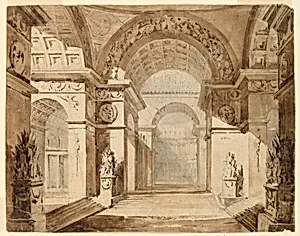
Stage Design, Palace Interior
early 19th century
Classification
theater
Department
Smithsonian Collection
Museum
Smithsonian American Art Museum
Credit
Museum purchase through gift of various donors and from Eleanor G. Hewitt Fund
Accession Number
1938-88-237
Rights
Public Domain
About this artwork
Research in Progress
Art Historical Context
**Stage Design, Palace Interior** by Antonio Sarti (1797–1880) invites visitors into the opulent world of early th-century Italian theater. As a skilled scenographer, Sarti crafted this design to evoke the grandeur of a royal palace, complete with architectural details that would have transformed stages into immersive spectacles. Created during a time when Romanticism flourished in Italy, such designs were essential for operas and plays at renowned venues like Milan's La Scala, blending neoclassical elegance with dramatic flair to heighten emotional narratives. Theatrical stage designs like this one were pivotal in the evolution of scenography, allowing audiences to escape into lavish interiors that mirrored the era's fascination with historical and aristocratic splendor. Sarti's work reflects the technical ingenuity of the period, where perspective tricks and painted backdrops created depth on two-dimensional surfaces, fooling the eye into believing in three-dimensional luxury. Though the medium remains under study, its preservation in the Smithsonian American Art Museum underscores its enduring value as a window into performance arts. Today, this piece from the Smithsonian Collection highlights how visual arts intersected with live theater, captivating crowds and influencing modern set design. A testament to Italy's theatrical heritage, it reminds us of the magic behind the curtain.