
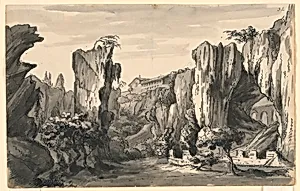
Stage Design, Rocky Valley with Buildings
early 19th century
Medium
theater
Classification
theater
Department
Smithsonian Collection
Museum
Smithsonian American Art Museum
Credit
Museum purchase through gift of various donors and from Eleanor G. Hewitt Fund
Accession Number
1938-88-302
Rights
Public Domain
About this artwork
Research in Progress
Art Historical Context
Step into the dramatic world of Romolo Achille Liverani *Stage Design, Rocky Valley with*, an evocative early 19th-century by the Italian artist (1809–1872). This theater piece imagines a rugged valley landscape dotted with architectural forms, perfectly suited to transport audiences into fantastical or historical scenes on the stage. Liverani, working during a time when Romanticism celebrated nature's grandeur and human intervention, crafted designs that blended scenic realism with theatrical illusion. As a medium of theater scenery, this work exemplifies the artistry behind 19th-century stagecraft, where painted backdrops and set pieces created immersive environments without modern technology. These designs were pivotal in operas, plays, and ballets across Europe, demanding skillful perspective, lighting effects, and atmospheric detail to evoke emotion and scale. Liverani's composition likely drew from Italy's rich tradition of spectacle, making everyday performances feel epic. Now part of the Smithsonian American Art Museum's collection—acquired through generous donors and the Eleanor G. Hewitt Fund—this piece invites us to appreciate the unsung heroes of live theater. With ongoing research, it promises deeper revelations about Liverani's contributions to scenic innovation.