
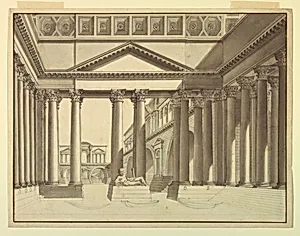
Stage Design, Temples on Riverside
early 19th century
Medium
theater
Classification
theater
Department
Smithsonian Collection
Museum
Smithsonian American Art Museum
Credit
Museum purchase through gift of various donors and from Eleanor G. Hewitt Fund
Accession Number
1938-88-235
Rights
Public Domain
About this artwork
Research in Progress
Art Historical Context
Giovanni Battista Piranesi, the renowned 18th-century Italian artist1720–1778), was a master of dramatic architectural visions, famous for his intricate etchings of Roman ruins fantastical prisons. Though dated to the early 19th centurylikely a posthumous work or design from his circle—"Stage Design, Temples Riverside" captures his signature style of grand, evocative scenery. This theatrical blueprint depicts ancient temples lining a serene riverside, blending real and imagined architecture to create an immersive, otherworldly stage. As a theater medium, the design exemplifies Piranesi's influence on scenography, where his expertise in perspective and light transformed static backdrops into dynamic illusions. Such designs were essential for 18th- and 19th-century opera and drama, evoking antiquity to heighten emotional impact. Piranesi's meticulous attention to crumbling arches, towering columns, and misty waters invites viewers to ponder the passage of time, much like his famous *Vedute di Roma* series. Now in the Smithsonian American Art Museum's collection, acquired through museum purchase and the Eleanor G. Hewitt Fund, this piece highlights Piranesi's enduring legacy in blending art with performance. Though research continues, it offers a window into how his visionary architecture animated the stages of Europe.