
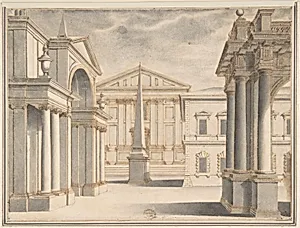
Piazza with Obelisk
16th century
Medium
Pen and brown ink, brush and gray wash
Dimensions
7-1/2 x 10 in. (19.1 x 25.4 cm)
Classification
Drawings|Ornament & Architecture
Department
Drawings and Prints
Museum
Metropolitan Museum of Art, New York, NY
Credit
Gift of Cornelius Vanderbilt, 1880
Accession Number
80.3.617
Rights
Public Domain
Tags
Art Historical Context
Step into the intricate world of 16th-century Italian draughtsmanship with *Piazza with Obel*, an anonymous architectural drawing that captures the grandeur of Renaissance urban spaces. Created using pen and brown ink with brush and gray wash on a modest 7-1/2 x 10-inch sheet, this work depicts a bustling piazza dominated by a towering obel—a nod to the era's fascination with ancient Egyptian repurposed in Italy. These obelisks, often relocated to Rome during the Renaissance, symbolized the revival of classical antiquity and papal power, gracing plazas like those near St. Peter's or Piazza Navona. The drawing's classification as "Ornament & Architecture" highlights its role in studying and idealizing public spaces, blending precise line work with subtle gray washes to convey depth, shadow, and atmospheric perspective. This technique was prized among Italian artists for preliminary designs or scholarly records, reflecting the period's humanist passion for proportion and harmony. Though anonymous, it exemplifies the anonymous mastery of workshops producing such detailed vignettes. A generous gift to the Metropolitan Museum of Art from Cornelius Vanderbilt in 1880, this piece invites us to ponder the timeless allure of piazzas as social hearts of Italian life, where architecture met spectacle.