
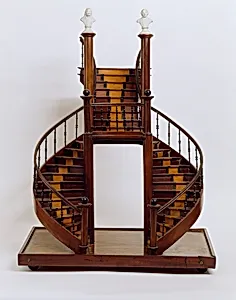
staircase model
early 19th century
Classification
models and prototypes
Department
Smithsonian Collection
Museum
Smithsonian American Art Museum
Credit
Gift of Eugene V. and Clare E. Thaw
Accession Number
2007-45-12
Rights
Public Domain
About this artwork
Research in Progress
Art Historical Context
Nestled in the Smithsonian American Art Museum's collection this *Staircase Model* hails from the renowned Sèvres Porcelain Manactory in France, established in 1756 and celebrated for its exquisite porcelain wares favored by royalty and nobility. Crafted in the early 19th century—a time of grand architectural revival during the Napoleonic era and Bourbon Restoration—this delicate prototype captures the era's fascination with neoclassical opulence. Donated by collectors Eugene V. and Clare. Thaw, it Sèvres' mastery in producing intricate, functional art. As a model and prototype, this piece likely served as a design study for larger architectural or decorative elements, showcasing the manufactory's innovative techniques in molding fragile porcelain into complex, multi-level structures like staircases. Sèvres artisans were pioneers in soft-paste porcelain, often enhanced with vibrant enamels and gilding, pushing the boundaries of what a ceramic medium could achieve in evoking marble or stone grandeur. Though research continues, this model highlights Sèvres' role in bridging fine art and design, influencing European decorative arts. Imagine it as a tiny testament to 19th-century ambition—where porcelain dreamed big. (198 words)