
Stamp seal
Unknown Artist
ca. 3rd–7th century CE
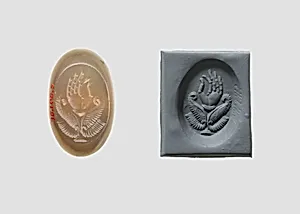
Medium
Chalcedony, yellow
Dimensions
1 1/16 × 11/16 × 7/8 in. (2.7 × 1.7 × 2.3 cm)
Classification
Stone-Stamp Seals
Culture & Period
Sasanian · Sasanian
Department
Ancient Near Eastern Art
Museum
Metropolitan Museum of Art, New York, NY
Credit
Dodge Fund, 1936
Accession Number
36.106.5
Rights
Public Domain
Tags
Art Historical Context
This exquisite yellow chalcedony stamp, crafted by an unknown Sasanian artist around the 3rd to 7th century CE, hails from the vibrant world of the Sasan Empire, which spanned modern-day Iran and beyond. Measuring just over an inch, these diminutive objects were everyday powerhouses in ancient Near Eastern society—used to imprint designs into soft clay or wax on documents, packages, or storage jars, ensuring authenticity and ownership. The Sasanian period, a golden age of Persian art and Zoroastrian culture, saw seals evolve into finely detailed emblems of status, often featuring symbolic motifs like the hands suggested by this piece's design. Carved in intaglio—a technique where the image is incised into the stone's surface—chalcedony's hardness and lustrous yellow hue made it ideal for durable, eye-catching seals. The precision required for such tiny engravings highlights the advanced lapidary skills of Sasanian artisans, who drew from a rich tradition blending Mesopotamian, Hellenistic, and indigenous Persian influences. Hands on seals might symbolize protection, authority, or ritual gestures, reflecting the empire's sophisticated bureaucracy and spiritual life. Today, this Dodge Fund acquisition of 1936 at The Metropolitan Museum of Art invites us to ponder the tactile world of ancient Persia, where a small stone could seal fates and fortunes.