
Stamp seal
Unknown Artist
ca. 3rd–7th century CE
Medium
Chalcedony
Dimensions
1.02 x 0.59 in. (2.59 x 1.5 cm)
Classification
Stone-Stamp Seals-Inscribed
Culture & Period
Sasanian · Sasanian
Department
Ancient Near Eastern Art
Museum
Metropolitan Museum of Art, New York, NY
Credit
Gift of Dr. and Mrs. Thomas L. Carter, 1984
Accession Number
1984.46.1
Rights
Public Domain
Tags
Art Historical Context
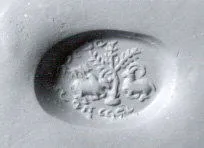
This exquisite stamp seal, crafted in chalcedony during the Sian period (ca. 3rd–7th century CE), hails from the vibrant culture of ancient Iran under the Sasanian Empire of the last great Persian dynasties before the Islamic conquest. Measuring just 1.02 x 0.59 inches, this tiny gem was likely used to imprint ownership marks, official documents, or personal seals into soft clay or wax, playing a crucial role in trade, administration, and daily life. Carved from chalcedony, a durable microcrystalline quartz prized for its fine texture and ability to capture intricate details, the seal features motifs of animals and trees—common symbols in Sasanian art evoking nature's abundance, royal power, and cosmic harmony. Its inscribed surface, typical of the classification, may bear text in Pahlavi script, blending artistry with functionality. Such seals reflect the empire's sophisticated stone-carving techniques, influenced by earlier Mesopotamian and Achaemenid traditions. Today, this artifact graces the Metropolitan Museum of Art's Ancient Near Eastern Art department, a generous gift from Dr. and Mrs. Thomas L. Carter in 1984. It offers a window into a world where even the smallest objects embodied cultural prestige and practical ingenuity.