
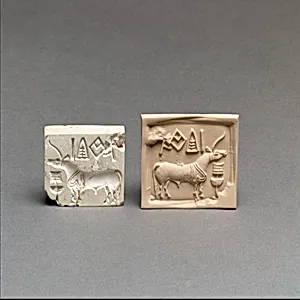
Stamp seal and modern impression: unicorn and incense burner (?)
Unknown Artist
ca. 2600–1900 BCE
Medium
Burnt steatite
Dimensions
1 1/2 x 1 1/2 x 3/8 in. (3.8 x 3.8 x 1 cm)
Classification
Stone-Stamp Seals-Inscribed
Culture & Period
Indus · Mature Harappan
Department
Ancient Near Eastern Art
Museum
Metropolitan Museum of Art, New York, NY
Credit
Dodge Fund, 1949
Accession Number
49.40.1
Rights
Public Domain
Tags
Art Historical Context
This exquisite stamp seal, crafted from burnt steatite 2600–1900 BCE during the Mature Harappan period the Indus Valley Civilization, a glimpse into one of the world's earliest urban societies. Housed in the Metropolitan Museum of Art Ancient Near Eastern Art department, this tiny artifact—measuring just 1 1/2 x 1 1/2 x 3/8 inches—was acquired through the Dodge Fund in 9. The Indus culture, flourishing in what is now Pakistan and northwest India, produced thousands of such seals for sealing goods, marking property, and possibly ritual purposes, reflecting advanced trade networks from Mesopotamia to the Arabian Gulf. Carved in intaglio, the seal's modern impression reveals a dynamic scene featuring a unicorn—a mythical creature iconic to Indus art, often depicted with a single horn and fierce posture—alongside what may be an incense burner. Burnt steatite, a soapstone hardened by firing, allowed for intricate detailing and durability, making these seals practical tools and symbols of status. Many, like this inscribed example, bear undeciphered Indus script, hinting at a lost language of administration and belief. These seals highlight the Harappans' mastery of standardization and symbolism, predating writing systems like cuneiform. The "unicorn," possibly a stylized antelope or rhinoceros, evokes mystery: was it sacred, protective, or totemic? A testament to ancient ingenuity, it invites us to ponder the daily lives of a people who built planned cities without palaces or temples.