
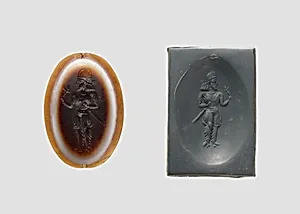
Stamp seal: standing noble holding a flower
Unknown Artist
ca. 3rd–early 4th century CE
Medium
Sardonyx
Dimensions
1 5/16 × 7/8 × 1/4 in. (3.3 × 2.2 × 0.6 cm)
Classification
Stone-Stamp Seals
Culture & Period
Sasanian · Sasanian
Department
Ancient Near Eastern Art
Museum
Metropolitan Museum of Art, New York, NY
Credit
Rogers Fund, 1922
Accession Number
22.139.41
Rights
Public Domain
Tags
Art Historical Context
This exquisite stamp seal, carved from sardonyx around the 3rd to early 4th century CE, captures a standing noble gracefully holding a flower. Measuring just 1 5/16 × 7/8 × 1/4 inches, its petite size belies its intricate craftsmanship, typical of Sasanian stone seals from ancient Iran. Acquired by the Metropolitan Museum of through the Rogers Fund in 2, it now resides in the Department of Ancient Near Eastern Art. In the Sasanian Empire (224–651 CE), stamp seals like this were essential tools for authentication, used to imprint wax or clay on documents, parcels, and jewelry. Sardonyx, a durable banded variety of chalcedony with striking red and white layers, was prized for its hardness—ideal for fine engraving—and its translucent beauty, which allowed light to play across the design. The noble figure, rendered in precise intaglio, evokes the refined iconography of Sasanian elite culture, where men in flowing garments and floral motifs symbolized status and refinement. Such seals offer a glimpse into daily administrative life and artistic sophistication, blending utility with elegance in this golden age of Persian art.