
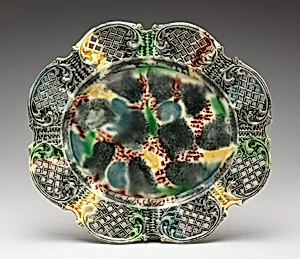
Stand
ca. 1760
Medium
Lead-glazed earthenware (creamware)
Dimensions
Overall: 10 × 9 in. (25.4 × 22.9 cm)
Classification
Ceramics-Pottery
Culture
British, Staffordshire
Department
European Sculpture and Decorative Arts
Museum
Metropolitan Museum of Art, New York, NY
Credit
Rogers Fund, 1912
Accession Number
12.142.9
Rights
Public Domain
Art Historical Context
This elegant stand, crafted around 1760 in Staffordshire, England, exemplifies the refined creamware that transformed British pottery during the mid-eighteenth century. Made of lead-glazed earthen, it features the smooth, pale surface and subtle sheen characteristic of creamware, a durable yet affordable alternative to imported porcelain. Such stands were practical household items, likely designed to support teapots or dishes while protecting surfaces from heat. The piece is associated with the innovative techniques of potter Thomas Whieldon, whose workshop pioneered colored glazes and improved earthenware bodies. Staffordshire’s thriving ceramic industry benefited from local clay resources and growing demand for stylish tableware among Britain’s expanding middle class. Whieldon’s influence helped elevate everyday objects into expressions of taste and ingenuity. Today, this stand offers a glimpse into the era’s blend of utility and artistry, highlighting how British potters adapted continental influences to create distinctly national styles that would later inspire figures like Josiah Wedgwood.
About the Artist
Whieldon type
Whieldon-type is not a single artist but a catalogue attribution used by museums for unmarked mid-18th-century Staffordshire earthenware in the manner of Thomas Whieldon (1719-1795), the celebrated English potter of Fenton Vivian. Whieldon perfected lead-glazed cream-colored earthenware streaked and dappled with metallic oxides - manganese browns, copper greens, cobalt blues - producing the mottle...