
Stand
1760–65
Medium
Soft-paste porcelain decorated in polychrome enamels
Dimensions
Overall (confirmed): 1 1/2 × 9 9/16 × 8 in. (3.8 × 24.3 × 20.3 cm)
Classification
Ceramics-Porcelain
Culture
French, Mennecy
Department
European Sculpture and Decorative Arts
Museum
Metropolitan Museum of Art, New York, NY
Credit
The Charles E. Sampson Memorial Fund, 1984
Accession Number
1984.121
Rights
Public Domain
Tags
Art Historical Context
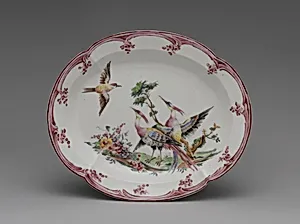
This exquisite *Stand* from the Mency porcelain manufactory, created between 1760 and 1765, exemplifies the golden age of French soft-paste porcelain. Nestled near Paris, Mennecy was one of Europe's pioneering factories, producing delicate wares that rivaled the royal Sèvres works. Soft-paste porcelain blend of clay and ground glass fired at lower temperatures—allowed for intricate shapes and vibrant decorations impossible with earlier materials, marking a key innovation in 18th-century ceramics. Adorned with polychromeels in rich hues, the stand features lively motifs of birds amid blooming flowers and lush plants, capturing the playful elegance of the Rococo style. Measuring just 1 ½ inches high and about 9 ½ by 8 inches wide, it likely served as a dainty plateau for desserts or confections at lavish aristocratic gatherings, blending utility with opulent artistry. Housed in the Metropolitan Museum of Art's European Sculpture and Decorative Arts department, this piece—acquired through The Charles E. Sampson Memorial Fund in 1984—highlights Mennecy's brief but brilliant legacy. Its survival offers a glimpse into the refined tastes of pre-Revolutionary France, where porcelain became a canvas for nature's whimsy.