
Standing Balarama or Nagaraja (Serpent King)
Unknown Artist
ca. mid-5th century
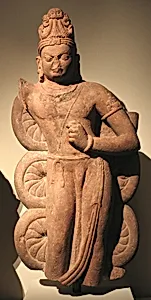
Medium
Red sandstone
Dimensions
H. 60 in. (152.4 cm); W. 21 in. (53.3 cm); D. 8 in. (20.3 cm)
Classification
Sculpture
Culture & Period
India (Uttar Pradesh or Madhya Pradesh) · Gupta period
Department
Asian Art
Museum
Metropolitan Museum of Art, New York, NY
Credit
Gift of Jeffrey B. Soref, in honor of Steve Kossak, 1991
Accession Number
1991.83.2
Rights
Public Domain
Tags
Art Historical Context
This striking red sandstone sculpture, titled *Standing Balarama oraja (Serpent King)*,ails from India's Gupta period (ca. mid-5th) in Uttar Pradesh or Madhya. Standing over five feet tall, the figure embodies the divine power of either Balarama—elder brother of Krishna and an incarnation associated with the cosmic serpent Shesha—or a majestic Nagaraja, the king of serpents revered in Hindu mythology. Crafted during the Gupta era, often called India's "Golden Age," it captures the period's mastery of stone carving, with smooth surfaces and idealized proportions that reflect classical Hindu ideals of beauty and divinity. Gupta sculptors from regions like Mathura excelled in red sandstone, a durable medium that allowed for intricate detailing and a warm, luminous polish. This piece exemplifies the era's artistic zenith, where Hinduism flourished through temple art and iconography, blending human form with supernatural grace. The ambiguity in identification—Balarama's heroic stance or the Naga's serpentine aura—highlights the fluid iconography of the time, inviting viewers to ponder its sacred role in ancient rituals. A gift to the Metropolitan Museum of Art in 1991, this sculpture stands as a testament to Gupta innovation, influencing centuries of South Asian art. Gaze upon it and feel the timeless reverence for nature's guardians.