
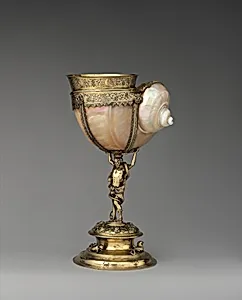
Standing cup
base and figure late 16th century, shell and mount 19th century
Medium
Silver gilt, turban shell
Dimensions
Overall: 10 5/8 × 5 1/2 × 6 1/2 in., 2.3 lb. (27 × 14 × 16.5 cm, 1040g)
Classification
Metalwork-Silver In Combination
Culture
Austrian, Breslau (Wrocław)
Department
European Sculpture and Decorative Arts
Museum
Metropolitan Museum of Art, New York, NY
Credit
Gift of J. Pierpont Morgan, 1917
Accession Number
17.190.600
Rights
Public Domain
Tags
Art Historical Context
Welcome to the Metropolitan Museum of Art's European Sculpture and Decorative Arts gallery, where you'll find the exquisite *Standing Cup* crafted by Austrian silversmith Casper Bendel from Breslaumodern-day Wrocław, Poland). Dating to the late 16th century for its silver-gilt base and figural elements, this piece was later enhanced in the 19th century a striking turban shell— a glossy, spiral seashell from the gastropod family—mounted in elegant silver gilt. Standing at just over 10 inches tall and weighing 2.3 pounds, it exemplifies Renaissance metalwork's fusion of craftsmanship and nature. Bendel, working in the prosperous Silesian city of Breslau under Habsburg influence, showcased virtuoso techniques like gilding (applying a thin gold layer over silver for a luxurious sheen) and intricate chasing on the base and supporting figure. Such "standing cups" were prized status symbols for Europe's elite, blending functional design with whimsical natural motifs—the turban shell evoking exotic seas and the era's Wunderkammer curiosity cabinets. A generous gift from financier J. Pierpont Morgan in 1917, this hybrid artwork highlights the enduring appeal of combining organic beauty with human artistry, bridging Renaissance opulence and 19th-century Romantic revival. Don't miss the shell's iridescent glow— a snail's perfect spiral turned treasure!