
Table snuffbox
ca. 1745–50
Medium
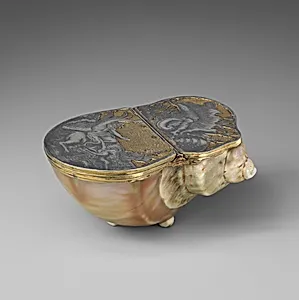
Green Turban snail shell; gilded, matted, punched, and engraved silver; niello
Dimensions
Overall: 2 1/4 × 4 1/8 × 2 1/2 in. (5.7 × 10.5 × 6.4 cm)
Classification
Metalwork-Silver In Combination
Culture
Russian, probably Velikiy Ustyug
Department
European Sculpture and Decorative Arts
Museum
Metropolitan Museum of Art, New York, NY
Credit
Purchase, Bequest of Emma A. Sheafer, by exchange, and Rogers Fund, 1995
Accession Number
1995.327
Rights
Public Domain
Tags
Art Historical Context
This exquisite table snuffbox, around 1745–50 and attributed to French Rococo artist Jacques Lajoüe for its designs, exemplifies the pinnacle of 18th-century Russian metalwork from Velikiystyug, a northern Russian center famed for intricate silver craftsmanship. Fashioned from a rare Green Turban snail shell—its iridescent, spiral form evoking the sea—the box is lavishly mounted in gilded silver adorned with matted, punched and engraved details, plus niello, a technique where black metallic alloys are inlaid into incised designs for dramatic contrast. Measuring just over 2 inches tall, it was a luxurious accessory for the elite, used to store finely ground tobacco snuff, a fashionable indulgence across Europe. The artwork's cultural significance lies in its fusion of natural wonder and virtuoso silversmithing, blending organic shell with mythological motifs like Triton, the Greek sea god, which nod to the shell's marine origins. Velikiy Ustyug artisans were renowned for such "silver in combination" pieces, often incorporating exotic materials and European-inspired Rococo flourishes—elegant, playful curves reflecting Lajoüe's style. Niello's enduring black sheen against gold highlights the technical mastery, making this snuffbox not just functional, but a miniature masterpiece of opulence and ingenuity. Today, housed in the Metropolitan Museum of Art's European Sculpture and Decorative Arts collection, it invites us to marvel at how 18th-century luxury objects bridged nature, myth, and human skill.