
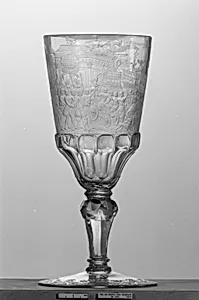
Standing cup
Unknown Artist
1745–46
Medium
Glass
Dimensions
Overall: 8 3/8 × 3 3/4 in. (21.3 × 9.5 cm)
Classification
Glass
Culture
German, Silesia
Department
European Sculpture and Decorative Arts
Museum
Metropolitan Museum of Art, New York, NY
Credit
Munsey Fund, 1927
Accession Number
27.185.91
Rights
Public Domain
Tags
Art Historical Context
This elegant *Standing Cup*, crafted in German Silesia around 1745–46, exemplifies the region's renowned glassmaking tradition during the Baroque-Rococo transition. Standing at 8 3/8 × 3 3/4 inches, this delicate glass vessel likely served as a ceremonial drinking cup, elevated on a footed base for display in affluent households. The inclusion of human figures—suggested by its tagging—hints at intricate engravings or moldings, a technique that brought narrative scenes or allegorical motifs to life on transparent surfaces, blending utility with artistry. Silesian glass from this era was prized across Europe for its clarity and virtuosity, produced in workshops that rivaled Bohemian centers. As a piece in the Metropolitan Museum of Art's European Sculpture and Decorative Arts collection (acquired via the Munsey Fund in 1927), it reflects the cultural prestige of such objects, used in lavish banquets or as diplomatic gifts. Though by an unknown artist, its survival underscores the fragility and allure of blown and cut glass, a medium that captured light to dramatic effect. Today, this cup invites us to ponder 18th-century craftsmanship, where everyday forms became canvases for human expression. A true gem of decorative arts!