
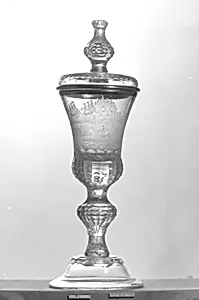
Standing cup with cover
ca. 1760
Medium
Glass
Dimensions
Overall (with cover): 12 5/8 × 3 5/8 in. (32.1 × 9.2 cm)
Classification
Glass
Culture
German, Hanover (Kalenberg)
Department
European Sculpture and Decorative Arts
Museum
Metropolitan Museum of Art, New York, NY
Credit
Munsey Fund, 1927
Accession Number
27.185.66a, b
Rights
Public Domain
Tags
Art Historical Context
This elegant standing cup with cover, around 1760 by the Lstein Manufactory in (Kalenberg), Germany, exemplifies the refined glassmaking traditions of mid-18th-century Europe Measuring 12⅝ × 3⅝ inches overall, this delicate glass vessel was designed as a luxurious drinking cup, complete with a fitted lid, reflecting the opulence of Rococo decorative arts. Lauenstein, a prominent manufactory, specialized in wheel-engraved glassware, a technique that allowed artisans to incise intricate designs into the surface with precision and depth, creating a frosted, shimmering effect under candlelight. The cup's engravings feature lively scenes of horses, buildings, and human figures, evoking pastoral or equestrian narratives popular among the aristocracy. These motifs not only served as aesthetic embellishments but also highlighted themes of leisure, travel, and nobility, making the piece a coveted item for grand dining tables. As part of the Metropolitan Museum of Art's European Sculpture and Decorative Arts collection (acquired via the Munsey Fund in 1927), it offers a window into German craftsmanship during a period when regional factories competed with Bohemian and Venetian glass giants, blending functionality with artistic virtuosity. Today, this cup invites visitors to appreciate the marriage of utility and beauty in everyday luxury, a testament to the enduring allure of 18th-century German glass.