
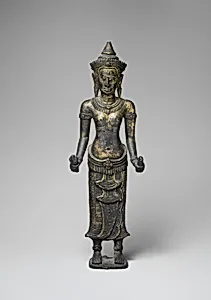
Standing Lakshmi(?)
Unknown Artist
13th century
Medium
Bronze with gilt
Dimensions
H. 13 1/4 in. (33.7 cm); W. 4 1/2 in. (11.4 cm); D. 2 1/4 in. (5.7 cm)
Classification
Sculpture
Culture
Cambodia or Thailand
Department
Asian Art
Museum
Metropolitan Museum of Art, New York, NY
Credit
Rogers Fund, 1932
Accession Number
32.38
Rights
Public Domain
Tags
Art Historical Context
Behold the graceful *Standing Lakshmi(?) *, a 13th-century bronze sculpture with intricate gilding, standing just over 13 inches tall. Crafted in the vibrant artistic traditions of Cambodia or Thailand, this petite figure (H. 13¼ in.; W. 4½ in.; D. 2¼ in.) captures the tentative likeness of Lakshmi, the Hindu goddess of wealth, prosperity, and good fortune. The gilt accents—gold leaf applied over the bronze—lend a luminous, divine glow, evoking the opulence of temple rituals where such icons were venerated. Emerging from Southeast Asia's Khmer-influenced era (circa 9th–15th centuries), this piece reflects the region's profound synthesis of Hinduism and local artistry. During the 13th century, royal workshops produced exquisite bronzes for worship, blending Indian iconography with fluid, naturalistic Khmer forms. The standing pose suggests poise and abundance, common in depictions of Lakshmi flanked by elephants or lotuses, symbolizing fertility and divine bounty. Acquired through the Rogers Fund in 1932, this sculpture now graces the Metropolitan Museum of Art's Asian Art collection. Its masterful lost-wax casting technique highlights the era's metallurgical prowess, making it a window into ancient devotion and craftsmanship that continues to inspire awe.