
Standing Man
1801 to 1825
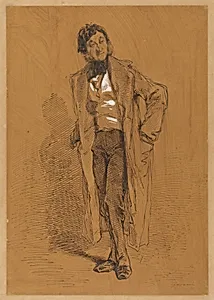
Medium
pen and brown ink with brown wash heightened with white on paper prepared with wash
Dimensions
Overall: 34.3 x 23.9 cm (13 1/2 x 9 7/16 in.) support: 45.3 x 33.5 cm (17 13/16 x 13 3/16 in.)
Classification
Drawing
Department
CG-E
Museum
National Gallery of Art, Washington, D.C.
Credit
Gift of Bertha Leubsdorf in memory of her husband, Karl Leubsdorf
Accession Number
1984.30.4
Rights
Public Domain
Art Historical Context
**Standing Man** by Paularni (1804–1866) is a captivating early 19th drawing that showcases the artist's masterful draftsmanship. Created between 1801 and 1825, this work captures a solitary male figure in a poised, stance, rendered on paper prepared with wash for added depth. Gavarni, a renowned French illustrator and caricaturist famous for his witty depictions of Parisian life in publications like *Le Charari*, began his career honing such figure studies, which laid the foundation for his later satirical lithographs. The medium—pen and brown ink with brown wash heightened with white—exemplifies Romantic-era techniques for achieving rich tonal contrasts and luminous highlights. The brown wash builds subtle shadows, while the white gouache adds a dramatic glow, mimicking the effects of oil painting on a smaller scale (34.3 x 23.9 cm overall). This mixed-media approach was ideal for preparatory sketches, allowing artists like Gavarni to explore anatomy and posture with fluid precision before committing to prints or larger compositions. Housed in the National Gallery of Art's CG-E Department, this drawing was a generous gift from Bertha Leubsdorf in memory of her husband, Karl. It offers visitors a glimpse into Gavarni's formative years, highlighting how everyday human forms fueled the vibrant cultural commentary that defined his legacy in 19th-century French art.
About the Artist
Paul Gavarni · 1804–1866
Paul Gavarni, born Sulpice Guillaume Chevalier on January 13, 1804, in Paris to a cooper father from Burgundy and mother Marie-Monique Thiémet—whose brother, painter Guillaume Thiémet, served as his godfather—began his career far from the art world. As a youth, he worked in a machine factory and studied mechanical drawing at the Conservatoire des Arts et Métiers in 1818, followed by evening classe...