
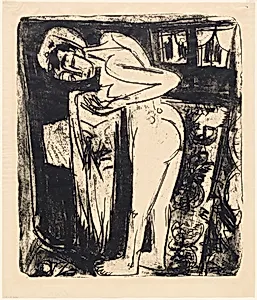
Standing Nude in a Room
Medium
lithograph on wove paper
Dimensions
sheet: 66.7 × 56.7 cm (26 1/4 × 22 5/16 in.)
Classification
Department
CG-W
Museum
National Gallery of Art, Washington, D.C.
Credit
Gift of Ruth Cole Kainen
Accession Number
2012.92.741
Rights
Public Domain
Art Historical Context
**Standing Nude in a Room** (1921) is a striking lithograph by Ernst Ludwig Kirchner a pioneering figure in German Expressionism and co-founder of the Die Brücke group. Created on wove paper measuring 66.7 × 56.7 cm, this print captures a solitary female nude standing confidently in an intimate interior space. Kirchner's bold, angular lines and dramatic contrasts embody the Expressionist drive to convey raw emotion and inner turmoil over realistic depiction, reflecting the turbulent post-World War I era in Germany when artists sought to break from academic traditions. Lithography, Kirchner's chosen medium here, allowed him to achieve rich tonal variations and expressive textures through greasy crayon and tusche on stone, producing editions that democratized his avant-garde vision. By 1921, after years of personal struggles including mental health challenges and exile in Switzerland, Kirchner's nudes often symbolized vulnerability and vitality amid modernity's alienation—a recurring theme in his oeuvre. Now housed in the National Gallery of Art's print collection (CG-W) as a gift from Ruth Cole Kainen, this work exemplifies Kirchner's mastery of printmaking and his enduring influence on modern art. Visitors will appreciate its psychological depth and the way it invites contemplation of the human form in confined spaces.
About the Artist
Ernst Ludwig Kirchner · 1880–1938
Ernst Ludwig Kirchner was born on May 6, 1880, in Aschaffenburg, Germany, to parents Ernst and Maria Kirchner, part of a family of Prussian descent that frequently relocated due to his father's career as a chemical technician. After early schooling in various towns, he studied architecture at the Königliche Technische Hochschule (Technical University) in Dresden from 1901 to 1905, taking courses i...