
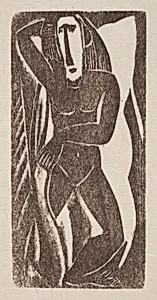
Standing Nude
1919-1920
Medium
woodcut in black on laid paper
Dimensions
image: 8.3 x 3.8 cm (3 1/4 x 1 1/2 in.) sheet: 24.8 x 15.9 cm (9 3/4 x 6 1/4 in.)
Classification
Department
CG-W
Museum
National Gallery of Art, Washington, D.C.
Credit
Gift of Jack and Margrit Vanderryn
Accession Number
1997.128.4
Rights
Public Domain
Art Historical Context
Max Weber's *Standing Nude* (1919-1920) is a striking woodcut print, rendered in bold black ink on laid paper. This intimate work measures just 8.3 x 3.8 cm for the image itself, with a larger sheet of 24.8 x 15.9 cm, close contemplation. Created shortly after World War I, captures Weber's modernist sensibilities as a Russian-born American artist who bridged European avant-garde influences with American innovation. A key figure in New York's early 20th-century art scene, Weber drew from Cubism, Expressionism and Primitivism, often distilling the human form into angular, rhythmic lines. The woodcut medium—carved from wood blocks and hand-printed—lends the piece a raw, tactile power, emphasizing sharp contrasts and simplified forms typical of Weber's printmaking. Nudes were a timeless motif in art, but Weber's abstracted figure reflects the era's fascination with fragmentation and emotional intensity, echoing contemporaries like Picasso. This gift to the National Gallery of Art from Jack and Margrit Vanderryn highlights its place in the CG-W Department's print collection. Visitors will appreciate how *Standing Nude* embodies the democratizing spirit of prints, making modernist experimentation accessible beyond oil paintings. Its modest scale belies a profound exploration of the body's essence, frozen in elegant poise.
About the Artist
Max Weber · 1881–1961
Max Weber (1881–1961), born in Białystok in the Russian Empire (now Poland) to Orthodox Jewish parents, immigrated to Brooklyn, New York, at age ten with his family, joining his tailor father.) There, he pursued art studies at the Pratt Institute under Arthur Wesley Dow, an innovative teacher who emphasized expression and form over traditional narrative, drawing from Japanese art and Paul Gauguin....