
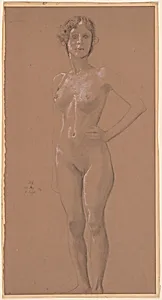
Standing Nude
1914
Medium
black chalk with gouache on brown paper
Dimensions
Overall (approximate): 64.5 x 34.2 cm (25 3/8 x 13 7/16 in.) support: 66.3 x 35.5 cm (26 1/8 x 14 in.)
Classification
Drawing
Department
CG-W
Museum
National Gallery of Art, Washington, D.C.
Credit
Gift of Lionel C. Epstein
Accession Number
1984.59.1
Rights
Public Domain
Art Historical Context
Max Klinger’s *Standing Nude* (1914) captures the human form with quiet intensity through black chalk and gouache on brown paper. Working late in career, the German artist the rich texture of the toned sheet to create subtle contrasts of light and shadow, allowing the figure to emerge with both sculptural solidity and delicate modeling. The addition of gouache introduces selective opacity and muted color, heightening the sense of volume while preserving the immediacy of a drawing. At approximately 64.5 by 34.2 centimeters, the work’s vertical format emphasizes the elongated pose, inviting viewers to consider the balance between anatomical precision and expressive line. Created on the eve of World War I, this study reflects Klinger’s lifelong fascination with the body as a vehicle for both classical ideals and modern psychological depth. Now part of the National Gallery of Art’s collection through the generosity of Lionel C. Epstein, the drawing offers visitors an intimate glimpse into an artist’s exploration of form, material, and the enduring power of the nude.
About the Artist
Max Klinger · 1857–1920
Max Klinger, born on February 18, 1857, in Leipzig to a wealthy family, emerged as one of Germany's most innovative artists across painting, sculpture, printmaking, and graphics. Demonstrating early talent, he enrolled at the Academy of Fine Arts in Karlsruhe in 1874 as a pupil of Karl Gussow, following his teacher to the Berlin Academy upon Gussow's appointment as director, and graduated in 1877 ...