
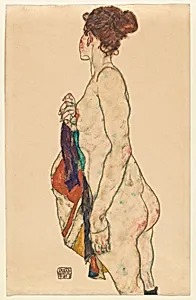
Standing Nude with a Patterned Robe
1917
Medium
opaque watercolor and charcoal on wove paper
Dimensions
sheet: 29.3 × 45.9 cm (11 9/16 × 18 1/16 in.)
Classification
Drawing
Department
CG-W
Museum
National Gallery of Art, Washington, D.C.
Credit
Gift of The Robert and Mary M. Looker Family Collection
Accession Number
2016.59.2
Rights
Public Domain
Art Historical Context
Egon Schiele's *Standing Nude with aed Robe* (1917) captures the artist's signature Expressionist intensity in a striking nude figure poised confidently on wove paper. At 29.3 × 45.9 cm, this drawing exemplifies Schiele's late works from the turbulent years of World War I, he was based in Vienna and grappling with personal and societal upheavals. A protégé of Gustav Klimt and key figure in the Vienna Secession, Schiele revolutionized portraiture and the nude with his raw, psychologically charged depictions of the human form—elongated limbs, angular poses, and unflinching eroticism that challenged Viennese conventions. Rendered in opaque watercolor and charcoal, the piece showcases Schiele's masterful technique: bold, jagged charcoal lines define the model's contorted anatomy, while vibrant watercolor builds volume and texture, particularly in the contrasting patterned robe that drapes suggestively. This mixed media on paper allowed for spontaneity and immediacy, heightening the emotional immediacy typical of Expressionism. The robe's decorative motif juxtaposes the vulnerability of the exposed body, symbolizing a tension between concealment and revelation. A gift to the National Gallery of Art from The Robert and Mary M. Looker Family Collection, this work invites viewers to explore Schiele's fearless gaze into human desire and fragility, just a year before his untimely death from the Spanish flu pandemic in 1918. It's a poignant reminder of his enduring influence on modern art.
About the Artist
Egon Schiele · 1890–1918
Egon Schiele (1890-1918) stands as one of the most provocative and psychologically penetrating artists of early twentieth-century European modernism. Born in Tulln an der Donau, Austria-Hungary, Schiele's brief but intensely productive life ended tragically at age twenty-eight when he and his pregnant wife Edith succumbed to the Spanish flu pandemic, mere days apart. Despite his truncated career, ...