
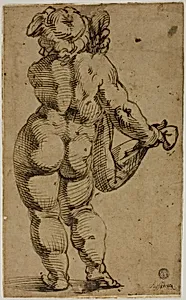
Standing Putto Seen From the Back
1570/75
Medium
Pen and brown ink over traces of black chalk, on tan laid paper, laid down on ivory laid paper
Dimensions
26.7 × 16.3 cm (10 9/16 × 6 7/16 in.)
Classification
pen and ink drawings
Department
Prints and Drawings
Museum
Art Institute of Chicago
Accession Number
82355
Rights
Public Domain
Art Historical Context
Bartolomeo Passarotti’s *Standing Putto Seen From the Back* (1570/75) offers a graceful glimpse into late-Renaissance draftsmanship. Working in Bologna during a period when artists increasingly valued preparatory studies, Passarotti used pen and brown ink over faint black chalk to explore the soft contours and subtle torsion of a child’s figure viewed from behind. The tan laid paper lends warmth to the delicate hatching that models the putto’s rounded limbs and the gentle curve of its spine. Drawings such as this one were essential tools for sixteenth-century artists, allowing them to refine poses and anatomy before transferring designs to paintings or frescoes. The choice of a putto—a motif rooted in classical antiquity and revived during the Renaissance—reflects the era’s fascination with ideal human form and playful innocence. Passarotti’s economical yet lively line captures both the figure’s volume and a sense of quiet movement, demonstrating why his drawings were prized by collectors even in his own time. Now housed in the Art Institute of Chicago’s Prints and Drawings department, this intimate sheet (roughly 10½ by 6½ inches) invites viewers to appreciate the quiet mastery of Renaissance draftsmanship and the enduring appeal of the putto as a symbol of artistic study and delight.
About the Artist
Bartolomeo Passarotti · 1529–1592
Comment on works: History, Portraits